
By Michael Neswal
The claim sounds great: Rooftop solar could cover up to 40% of the EU’s long-term electricity demand, as has recently been asserted once again. Who would want to disagree? Solar energy, decentralized, democratic, clean. A dream for PowerPoint slides, subsidy programs, and political Sunday speeches.
Only: dreams don’t pay grid costs. And they don’t carry loads either.
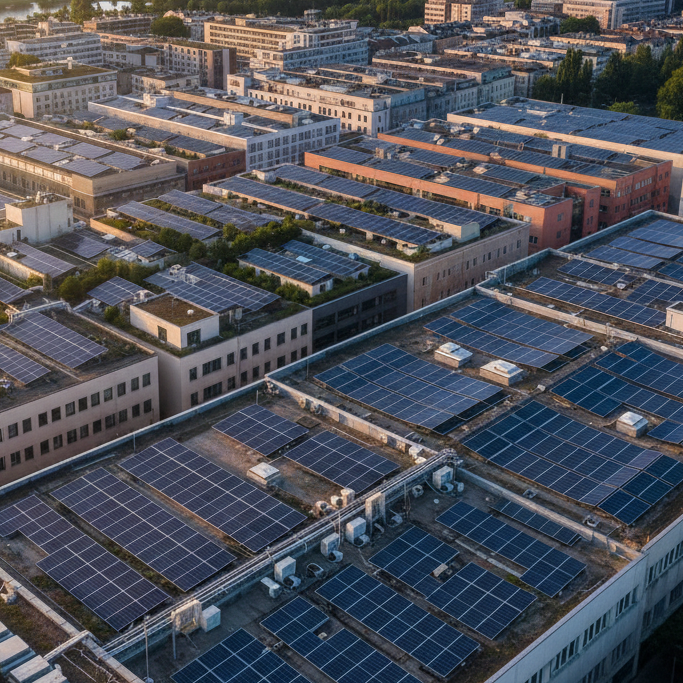
I have nothing against rooftop installations. On the contrary: anyone should be free to install photovoltaics on their roof if they want to. But anyone who seriously believes that rooftop PV will become the backbone of Europe’s electricity supply is ignoring some very uncomfortable realities.
And those realities are discussed far too little.
1. Rooftop PV is the most expensive form of photovoltaics
Apart from solar panels on the ISS, there is hardly anything more expensive.
Small system sizes, individual planning, complex installation, safety requirements, scaffolding, and complicated wiring make rooftop PV systematically more expensive than ground-mounted or infrastructure-based PV. Costs per installed megawatt are higher, and economies of scale are limited.
Yes, subsidies can disguise this.
No, they do not change the economic reality.
2. Statics? It’ll probably hold. Most likely.
A surprisingly uncomfortable point:
Very few roofs are structurally recalculated, before additional loads of several hundred kilograms are installed.
Snow, wind, aging building structures, and material fatigue suddenly become relevant. In practice, installations are often based on “experience” rather than on comprehensive engineering assessments.
This may work in individual cases.
As a European system strategy , it is risky.
3. Maintenance and monitoring: decentralization means hard to control
A few hundred large-scale plants can be professionally monitored.
Millions of small rooftop systems cannot.
Defective modules, inverter failures, shading, or soiling often reduce real output significantly below planned values. In many cases this goes unnoticed for long periods—or is simply accepted.
An electricity system based on assets that can hardly be monitored and only marginally maintained is not robust. It is fragile.
4. Curtailment? In theory yes – in practice often no
When grids are under stress, generation must be controllable.
Large plants are. Rooftop PV often is not.
Many rooftop systems cannot be curtailed at all, or only to a very limited extent, when needed. The consequences are well known: negative power prices, grid congestion, expensive redispatch—ultimately paid for by everyone.
Decentralization without controllability is not a strength.
It is a systemic risk.
“I consider rooftop photovoltaics useful – but not system-relevant. Europe needs scalable, controllable, and economically viable power generation. Rooftops provide contributions, but not a foundation.”
– Michael Neswal
Conclusion: rooftop PV is useful – but not the solution
Rooftop solar has its place: for self-consumption, local resilience, and participation. But not as the backbone of an industrial electricity system.
Anyone who wants to cover 40% of Europe’s electricity demand from rooftops is confusing installation numbers with system stability and technical feasibility with wishful thinking..
The energy transition will not be decided on single-family homes.
It will be decided by scalability, costs, controllability, and grid logic.
Everything else is—despite all sympathy—ideology with solar panels.
About the author
Michael Neswal is Senior Executive Director Projects and Partner at BlackSwan Capital and has more than 25 years of experience in the solar, semiconductor, and energy industries. His career spans all relevant stages of the value chain—from materials research and production process development to reliability assessments, project engineering, and the operation and maintenance of complex energy systems.
He has held senior positions at Sovello, Infineon, and Siemens, among others, and combines deep technological understanding with economic and systemic analysis. At BlackSwan Capital, he evaluates energy and infrastructure projects consistently based on scalability, cost structures, and real-world executability — beyond political narratives.
About BlackSwan
BlackSwan Capital is an independent, internationally active corporate finance and project advisory firm operating in situations where execution is decisive. The firm combines deep industrial and technical expertise with investment banking discipline , taking responsibility from structuring through to the realization of complex projects.
BlackSwan Capital works on global M&A transactions, energy and infrastructure projects, and investments in real estate and other illiquid assets. The focus is on robust structures, realistic assumptions, and the ability to bring projects to completion under market, technology, and regulatory pressure.

Leave a Reply